
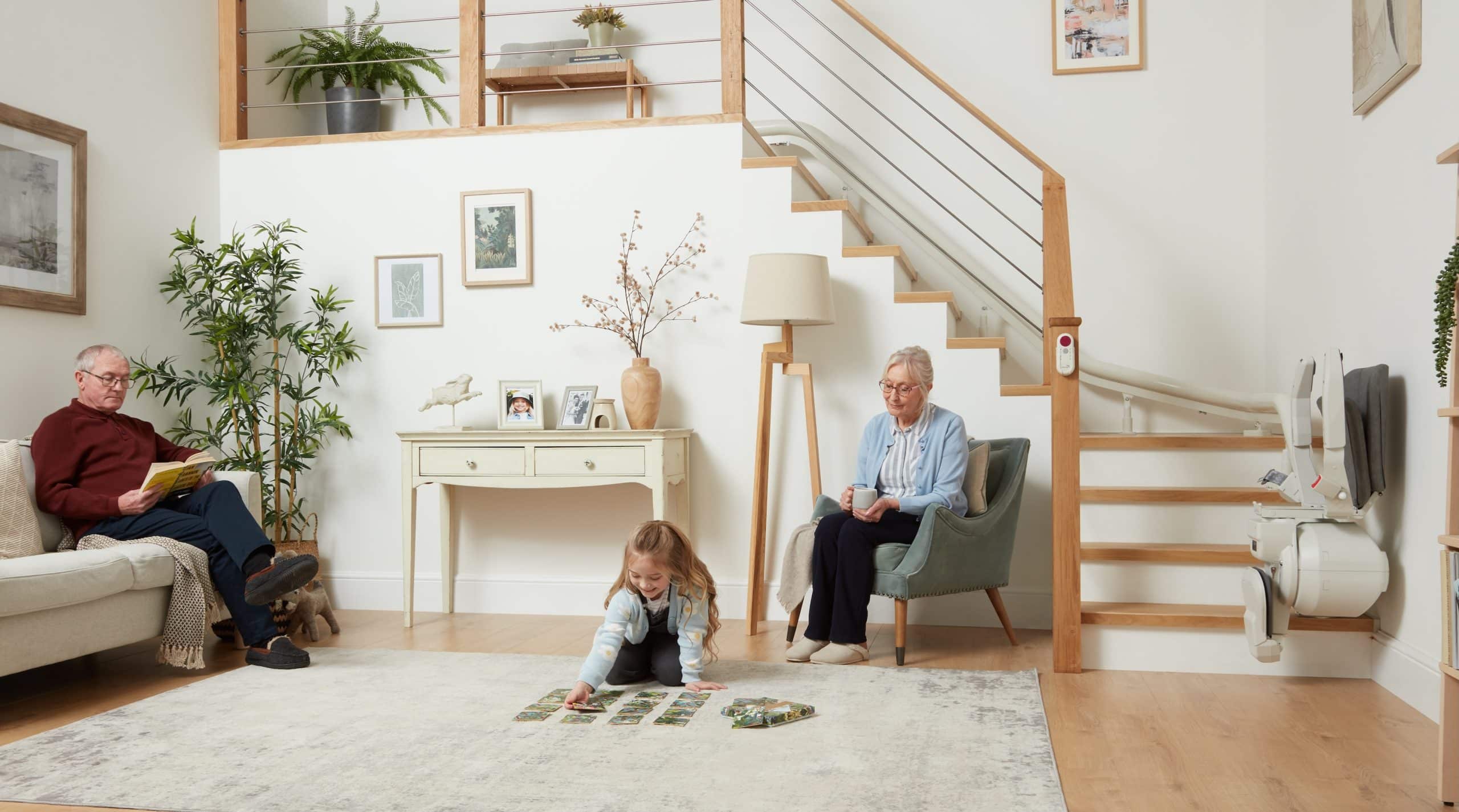
Straight or curved stairlift: Which one do you need?
When your parent starts struggling with the stairs, it can be a worrying time. You want to help them stay independent, safe, and comfortable in the home they love. But where do you start? One of the most common and effective solutions is installing a stairlift.
But once you start researching, you’ll quickly face one important question: Do we need a straight or curved stairlift?
In this guide, we’ll break down the key differences, how to choose the right one for your parents’ home, and what to expect from each option, without the jargon or hard sell.
What’s the difference between a straight and curved stairlift?
The difference is all in the name and the shape of the stairs.
-
A straight stairlift is designed for stairs that go up in one continuous, straight line. No turns, landings, or curves.
-
A curved stairlift is custom-made for staircases with bends, corners, spirals, or intermediate landings.
It sounds simple, but choosing between a straight or curved stairlift isn’t just about the staircase layout. It’s also about who will be using it, what features they’ll need, and how much space is available.
When a straight stairlift is the right choice
If your parents’ staircase is a simple straight flight from top to bottom, a straight stairlift is likely the best (and most cost-effective) option.
Straight stairlifts like the Ergo Straight from Multicare are:
-
Quick to install – often within a day
-
Suitable for both indoor and outdoor use (ideal for garden steps or front entrances)
-
Compact and foldable, so the stairs remain accessible for others
-
Affordable, with fewer customisations needed
They’re also ideal for people with:
-
Mild to moderate mobility issues
-
Good sitting balance
-
Sufficient landing space at the top and bottom of the stairs
When you need a curved stairlift
If the staircase includes one or more turns, such as a 90° or 180° bend, a winder, or a split-level landing, you’ll need a curved stairlift.
Curved models like the Ergo Curve or Ergo Ultimate are:
-
Custom-measured and hand-built to fit the exact shape of your staircase
-
Designed with a dual-rail system for extra stability on twists and turns
-
Able to start or finish on a landing or around a corner, saving space at entry/exit points
-
Packed with advanced safety and comfort features, including power footplates and swivel seats
They’re ideal for:
-
Homes with non-standard or narrow staircases
-
Users with reduced strength or flexibility
-
Situations where space is tight at the bottom of the stairs
-
Families who want a more seamless or discreet design
Comparing straight vs curved stairlifts
Here’s a quick comparison of key features and considerations:
| FEATURE | STRAIGHT STAIRLIFT | CURVED STAIRLIFT |
|---|---|---|
| Staircase Type | Straight stairs only | Stairs with bends, turns, or landings |
| Installation Time | Fast – usually within a day | Custom – can take longer due to bespoke design |
| Cost | Lower | Higher – due to custom rail and fitting |
| Rail Type | Pre-made straight rail | Tailor-made dual-rail system |
| Space-Saving Options | Folding arms, seat, and footplate | Folding options plus wraparound parking |
| Suitability for Outdoors | Yes | Usually indoor only |
| Swivel Seat Options | Manual or powered | Manual, powered, or Active Power Swivel |
| User Needs | Basic mobility support | Advanced support for more complex needs |
| Example Models | Ergo Straight | Ergo Curve, Ergo Ultimate |
Key considerations before you decide
Before deciding on a straight or curved stairlift, ask yourself:
1. What shape is the staircase?
If there’s even one turn, a curved stairlift is usually required.
2. Who will be using it, and what are their physical needs?
Do they have reduced mobility, difficulty bending, or balance issues?
3. Is there enough room at the top and bottom of the stairs?
Curved models can park neatly around corners if space is tight.
4. What’s your budget?
Straight stairlifts are typically more affordable, but curved options offer more flexibility.
5. Do you need the stairlift quickly?
Straight stairlifts can be installed much faster if time is critical.
Not sure what you need? A home assessment can help
Sometimes it’s not obvious whether you need a straight or curved stairlift, especially if your stairs are narrow, unusually shaped, or if your parents’ mobility is likely to change over time.
That’s where a free, no-obligation home assessment can make all the difference. A specialist will:
-
Assess the staircase shape and layout
-
Ask about the user’s mobility and lifestyle needs
-
Recommend features that would support long-term independence
-
Suggest the best-fit model, whether that’s straight, curved, or even outdoor
Making life easier without leaving the home you love
Ultimately, the goal of any stairlift, whether straight or curved, is the same: to help your parent move freely and safely around their home.
By understanding the difference between stairlift types, you’re in a stronger position to support them with confidence, reduce risks like falls, and delay (or even avoid) the need for more drastic changes like moving house.
Need Expert Advice?
Multicare Medical offers expert advice, professional installation, and friendly support with no external contractors involved. Whether you’re looking for a quick solution or exploring long-term adaptations, we’re here to help you make the right decision for your parent and your peace of mind.
Download the Multicare Stairlift Collection Brochure for more information on the full range available.
Call: 0800 298 6000
Email: [email protected]
Click to submit an enquiry
Multicare Medical: ‘Helping you deliver better healthcare’ since 1988